Orbio: AI usage as a token, paid for by trading fees
Orbio turns AI usage into a token called CREDIT and pays $ORBIO stakers in it from trading fees. It made ~$147K in 30 days, 88% of it from people trading $ORBIO. The private AI chat it launched on Nov 3 is its shot at revenue from people using AI.
Research snapshot · 6 Nov 2026
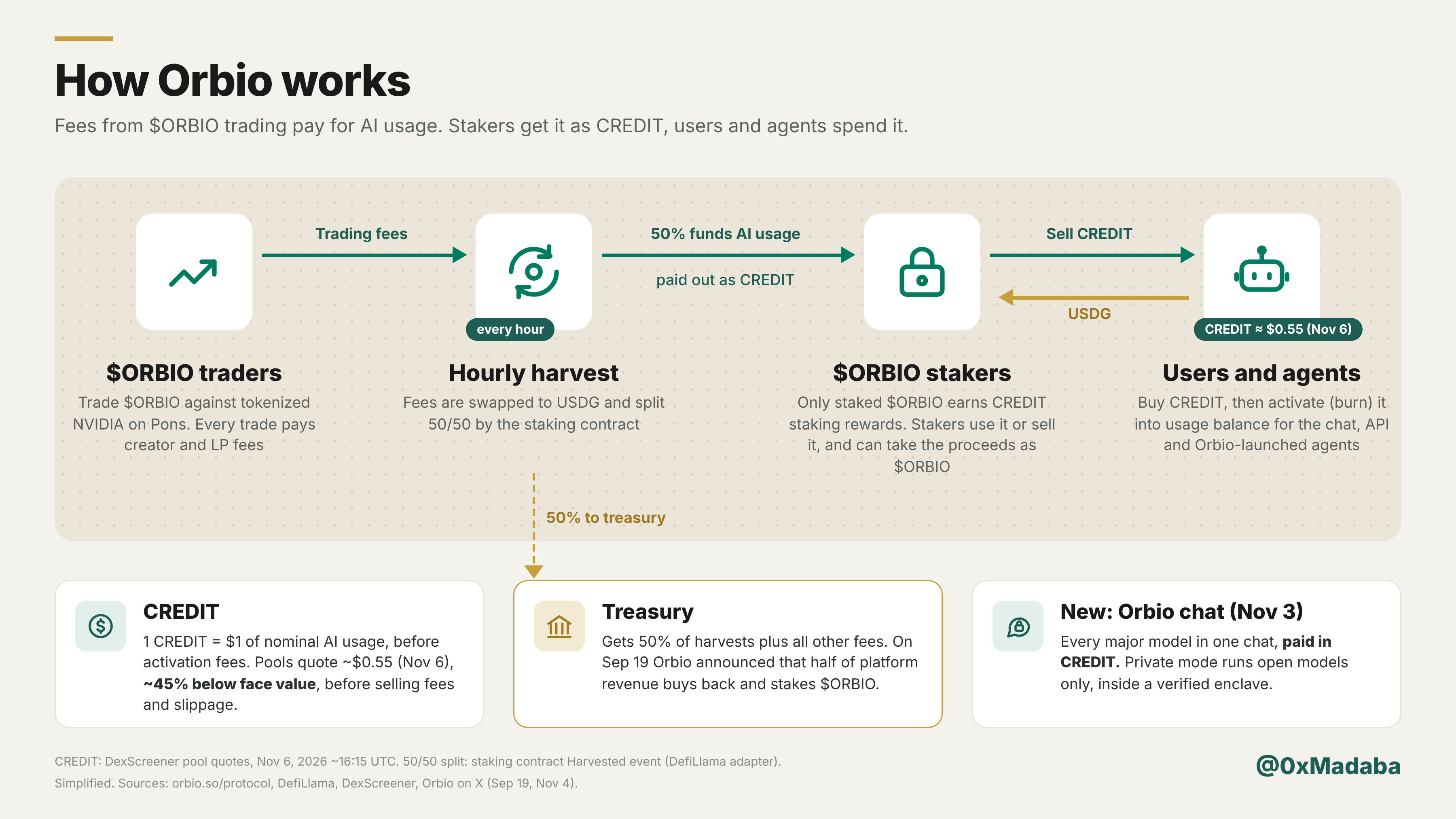
How it works
1 CREDIT stands for $1 of AI usage at Orbio's listed prices. CREDIT trades at ~$0.55, so Claude Opus 5.5 output listed at 20 CREDIT per 1M tokens costs ~$11 before activation fees. $ORBIO trading fees are swapped to USDG every hour: half goes to the treasury, half backs CREDIT rewards for stakers. A launchpad lets agents fund their own AI usage from their token's trading fees.
Where the money comes from
~$147K from Oct 7 to Nov 5: ~$130K (88%) from $ORBIO trading fees, ~$13K (9%) from the agent launchpad and ~$4K (3%) from CREDIT sales and activation. $65K went to stakers as CREDIT and $82K to the treasury. About 30% of supply is staked, for a yield of ~9% a year at face value or ~5% at the CREDIT market price.
The main risk
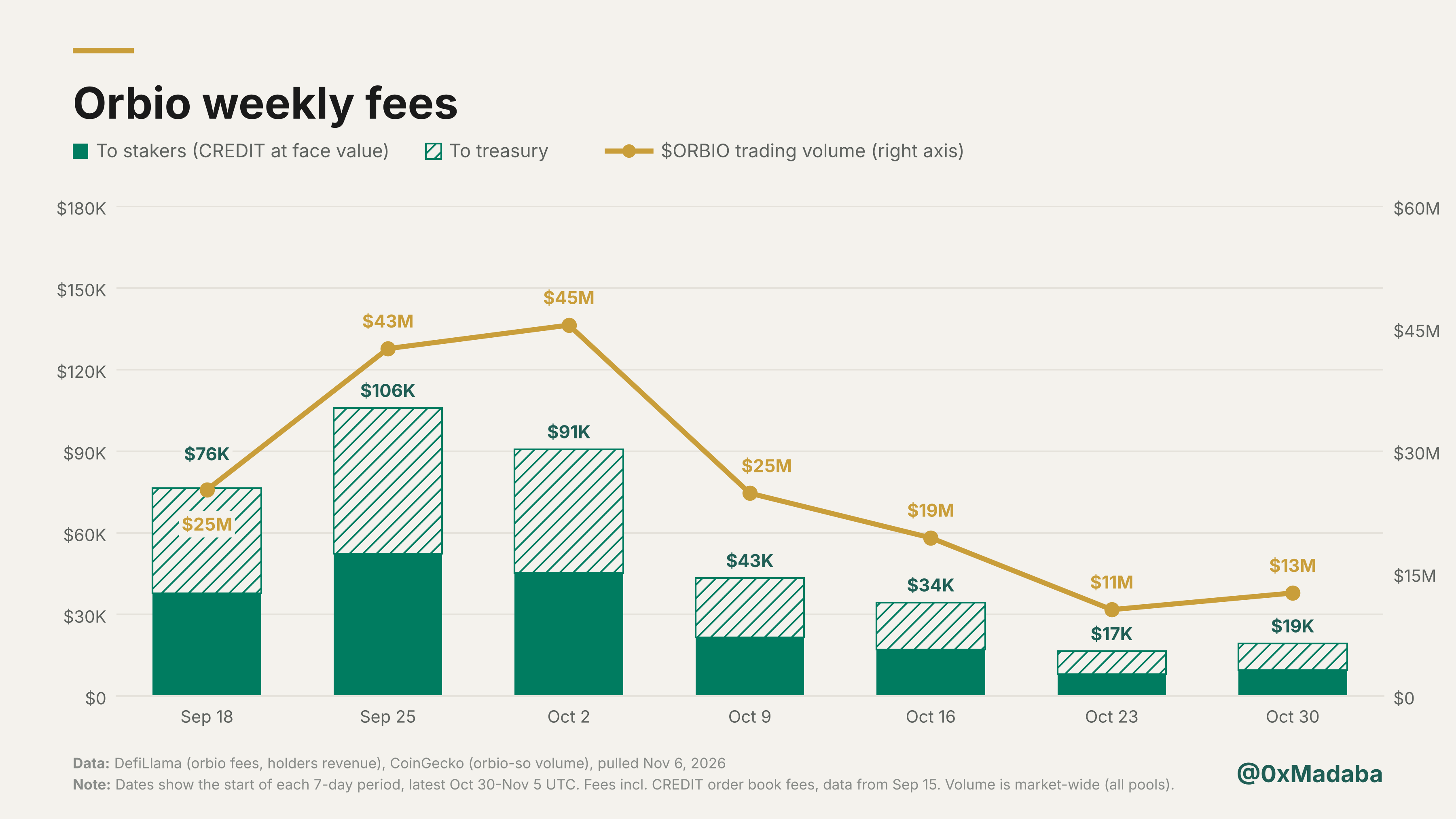
Weekly fees fell from a $106K peak in late September to $19K, with $ORBIO trading volume down from ~$45M to ~$13M a week. Fees per $1 of volume halved from ~0.30% to ~0.15%, as more trading routes through Ramses and Uniswap v3 pools that pay Orbio nothing. The new chat has to bring in paying users.
Compared to $VVV
$ORBIO trades at ~37x its staker allocations at face value, or ~66x with CREDIT at $0.55. $VVV trades at ~79x its burns, ~131x on fully diluted value. VVV burns reduce supply for every holder, while ORBIO's CREDIT rewards go only to stakers. Market caps as of 6 Nov: ~$29M for ORBIO, ~$1.01B for VVV.
Sources & related reading
Keep reading
Priors: can AI agent credit create value for the token?
AI agents can hold wallets and pay per call, but nobody lends them $5 before their work pays. Priors is building that credit layer on Robinhood Chain, with very little real demand so far.
Read more →
Elysium economics: what it means for KNTQ and HYPE
Half of Elysium's sequencer revenue buys KNTQ, while 12.9M KNTQ unlock every month from Nov 27. Today's holder revenue covers about 3% of that. HYPE only gains if Elysium brings new trading, listings and USDC to Hyperliquid.
Read more →